
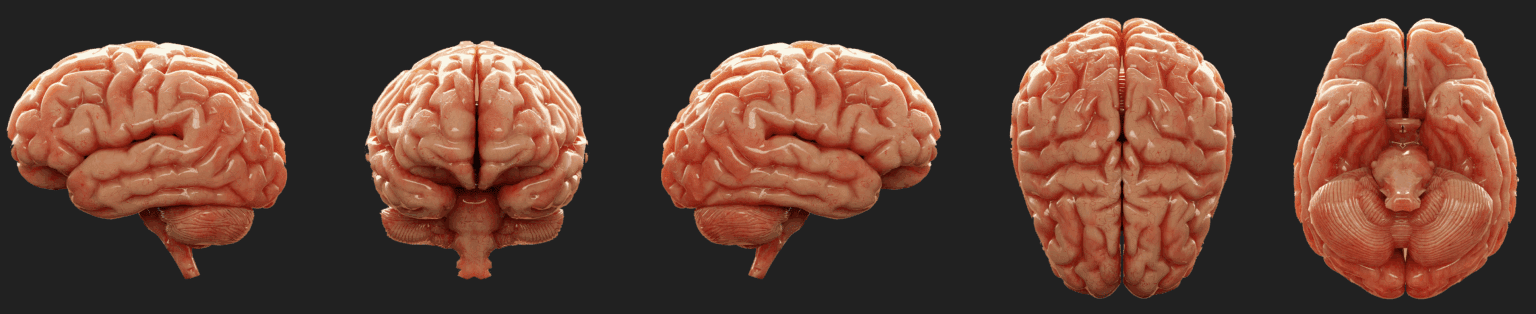

1-Parietal control of prefrontal neural timescales shapes visual salience.
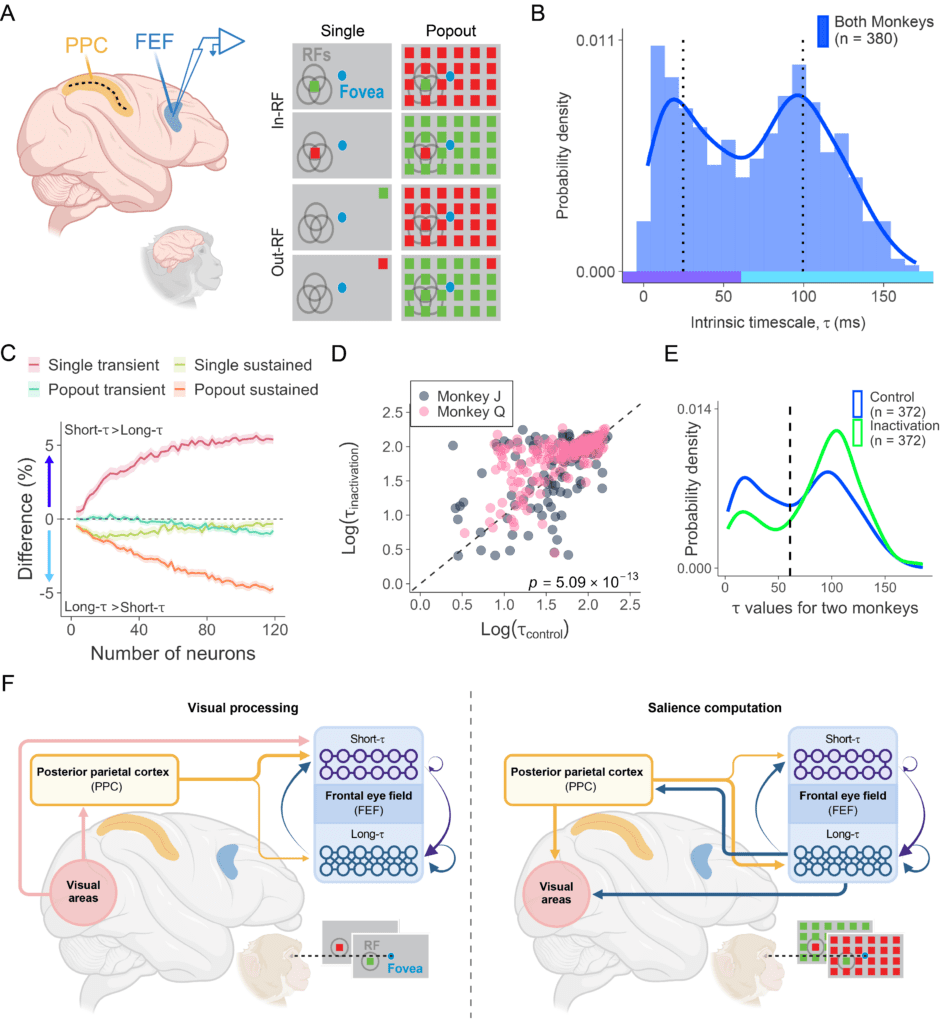
The frontal eye field (FEF) and posterior parietal cortex (PPC) are key components of the brain’s attention network, but how parietal input shapes prefrontal neural dynamics has remained unclear. In this study, we recorded from FEF neurons in macaques and found two distinct populations with different intrinsic timescales: short-timescale neurons, which were more strongly involved in rapid visual processing, and long-timescale neurons, which showed stronger sustained representation of visual salience. By inactivating PPC, we found causal evidence that parietal input regulates these prefrontal dynamics: neural timescales in FEF became slower overall, with larger effects in short-timescale neurons, while salience representation was selectively disrupted, especially in long-timescale neurons. These findings show that long-range interactions between parietal and prefrontal cortex shape the temporal dynamics that support visual attention.
Soyuhos, O., Zirnsak, M., Chaudhuri, R., & Chen, X. (2026). Selective control of prefrontal neural timescales by parietal cortex. Nature Communications, 17, 3687. https://doi.org/10.1038/s41467-026-70326-1.
2-Intrinsic networks of the FFA and PPA predict domain-specific perceptual performance.
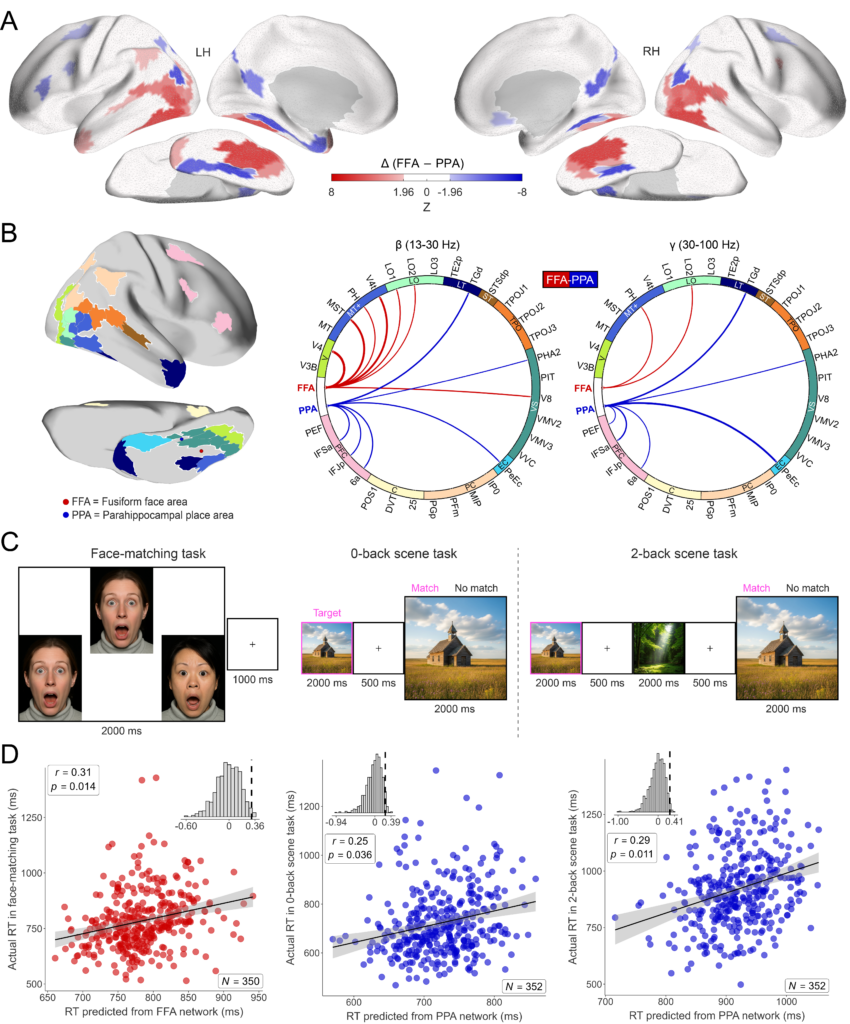
Face and scene perception rely on specialized cortical regions, but how these regions are embedded within larger intrinsic brain networks remains unclear. Using resting-state fMRI and MEG, we found that the fusiform face area (FFA) and parahippocampal place area (PPA) anchor distinct functional connectomes with different spatial and frequency-specific profiles. The FFA network was more strongly linked to lateral occipitotemporal, inferior temporal, and temporoparietal regions, whereas the PPA network was more strongly linked to ventromedial visual, posterior cingulate, and entorhinal-perirhinal regions. This segregation was also reflected in beta- and gamma-band MEG connectivity. Importantly, connectome-based predictive modeling revealed a double dissociation: intrinsic connectivity within the FFA network predicted performance on a face-matching task, while intrinsic connectivity within the PPA network predicted performance on scene tasks, but not vice versa. These findings show that face and scene perception are supported by distinct intrinsic large-scale networks whose architecture is linked to individual differences in behavior.
Soyuhos, O., Scarpa, A., & Baldauf, D. (2026). Distinct resting-state connectomes for face and scene perception predict individual task performance. Human Brain Mapping, 47(5), e70498. https://doi.org/10.1002/hbm.70498.
3-Connectivity fingerprints of FEF and IFJ suggest spatial and nonspatial processing in the prefrontal cortex.
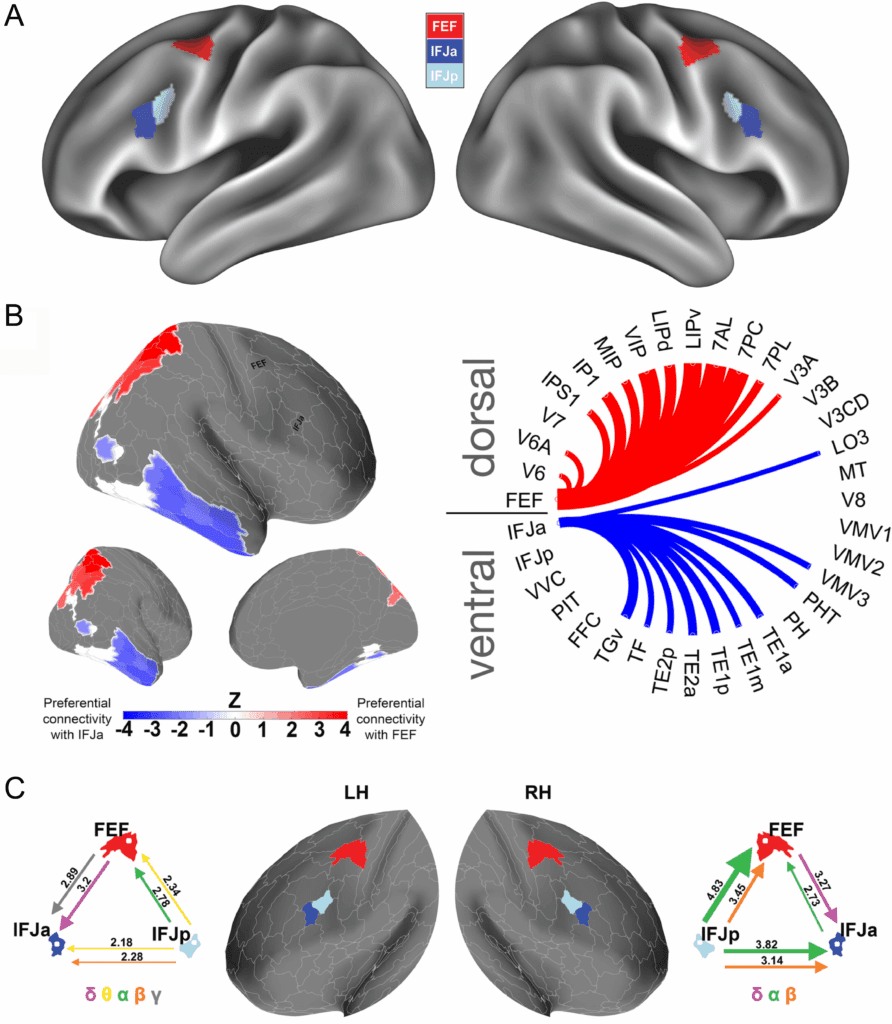
The frontal eye field (FEF) and inferior frontal junction (IFJ) are both key regions in attention and working memory, but their distinct large-scale connectivity patterns had not been directly compared. Using resting-state MEG and seed-based functional connectivity analyses, we found a clear dissociation between these two prefrontal regions: FEF was more strongly coupled to the dorsal visual stream, especially superior parietal and intraparietal regions, whereas anterior IFJ (IFJa) was more strongly coupled to ventral visual and temporal regions associated with feature- and object-based processing. These interactions were also frequency-specific, with FEF showing stronger coupling to dorsal regions particularly in beta-band activity, while IFJa showed stronger coupling to ventral regions especially in delta and gamma bands. Together, these findings show that the prefrontal cortex carries distinct dorsal and ventral connectivity fingerprints, consistent with spatial versus nonspatial processing in attention and working memory.
Soyuhos, O., & Baldauf, D. (2023). Functional connectivity fingerprints of the frontal eye field and inferior frontal junction suggest spatial versus nonspatial processing in the prefrontal cortex. European Journal of Neuroscience, 57(7), 1114–1140. https://doi.org/10.1111/ejn.15936.
4-Scene meaning guides overt attention in macaques during free viewing.

Classical models of visual attention explain eye movements through low-level visual salience, but studies in humans have shown that gaze is also strongly guided by scene meaning, the spatial distribution of semantic informativeness as judged by human observers. Whether this attentional bias is uniquely human or shared across primates had remained unknown. In this study, we recorded eye movements from rhesus macaques freely viewing naturalistic indoor scenes and modeled fixation selection using meaning maps alongside image-based salience and center bias. We found that meaning robustly guided where monkeys looked, with an influence comparable to that of visual salience that was present from the earliest fixations of each trial. The two signals combined sub-additively: high-meaning regions were fixated regardless of their salience, whereas salience played a larger role as meaning decreased. Meaning-based guidance was also shaped by behavioral context. It was stronger in unfamiliar environments than in the monkeys’ own housing and laboratory spaces, where exploration broadened toward less meaningful regions, and it grew stronger when monkeys were more engaged with a scene. These findings suggest that macaques share the human attentional bias toward informative scene regions and establish a behavioral foundation for investigating its neural mechanisms.
Soyuhos, O., Hayes, T. R., Hu, W., Hamel, T. P., Sevak, B., Henderson, J. M., & Chen, X. (2026). Meaning-based guidance of attention in rhesus monkeys during naturalistic scene viewing. eLife, 15. https://doi.org/10.7554/eLife.111311.1.